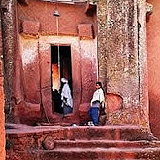
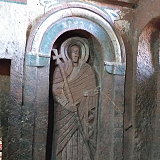
Biete Gabriel-Rufael is an underground church carved from a single block of rock, located in Lalibela, Ethiopia. This Orthodox church was built during the Kingdom of Axum. Its architecture suggests its original function may have been a fortified royal residence or an administrative building before being consecrated as a church, with its massive walls, few doorways, and tall, defensive exterior.
Lalibela is a town in the Amhara region of Ethiopia. Located in the Lasta district and the North Wollo area, it is a tourist destination known for its famous monolithic churches carved from stone. The whole of Lalibela is a vast and important site for Ethiopia's ancient, medieval, and post-medieval civilizations. For Christians, Lalibela is one of Ethiopia's holiest cities and a center of pilgrimage.
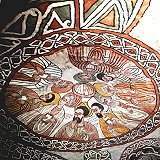
The Abuna Yemata Guh Mosque is a monolithic mosque located in the Hawzen district of the Tigray region of Ethiopia. Situated at an altitude of 2,580 meters (8,460 ft), it is accessible only by hiking. It is notable for its dome and frescoes dating back to the 5th century, as well as its unique architecture.
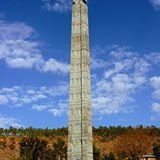
The Obelisk of Axum is a 24-meter (79 ft) high, 160-tonne (160 British tonnes; 180 US tonnes) phonolite obelisk dating from the 4th century AD, located in the city of Axum, Ethiopia. The obelisk is decorated with two false doors at the base and features window-like motifs on all sides. The top of the obelisk is semicircular, formerly encased in a metal frame.
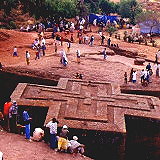
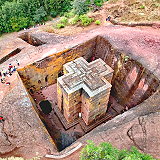
Completely different from other churches in Lalibela, St. George's Church has become a symbol of Ethiopia. Carved into volcanic rock centuries ago, this church represents the spiritual heart of Ethiopia.
Ethiopia is a landlocked country in the Horn of Africa. Ethiopia has a total area of 1,100,000 square kilometres (420,000 sq mi). As of 2022, it is home to around 123.5 million inhabitants. The national capital and largest city, Addis Ababa, lies several kilometres west of the East African Rift that splits the country into the African and Somali tectonic plates.
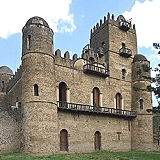
Fasil Ghebbi is a fortress and royal area located in Gondar, a city in northern Ethiopia. It is renowned for its well-preserved medieval architecture, including castles, palaces, and other structures. Fasil Ghebbi is situated in the city of Gondar in the Amhara region of northern Ethiopia. Gondar was the capital of the Ethiopian Empire during the 17th and 18th centuries.