Artigas (Capital: Artigas)
Canelones (Capital: Canelones)
Cerro Largo (Capital: Melo)
Colonia (Capital: Colonia del Sacramento)
Durazno (Capital: Durazno)
Flores (Capital: Trinidad)
Florida (Capital: Florida)
Lavalleja (Capital: Minas)
Maldonado (Capital: Maldonado)
Montevideo (Capital: Montevideo)
Paysandu (Capital: Paysandu)
Rio Negro (Capital: Fray Bentos)
River (Capital: Rivera)
Rocha (Capital: Rocha)
Salto (Capital: Salto)
San Jose (Capital: San Jose de Mayo)
Soriano (Capital: Mercedes)
Tacuarembo (Capital: Tacuarembo)
Treinta y Tres (Capital: Treinta y Tres)
Uruguay »
»
| Colonia | |
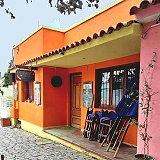
| Colonia is a department of southwestern Uruguay. The department's population was 135,717 in 2023. The departmental capital is Colonia del Sacramento, the country's second oldest city. Founded by the Portuguese in 1680, Colonia del Sacramento holds countless treasures and captivates with its beautiful beaches, modern attractions, upscale boutiques, and luxurious restaurants. | |
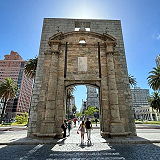
| Gateway of the Citadel | |
| Puerta de la Ciudadela is located at the entrance of Ciudad Vieja adjacent to the Plaza Independencia in Montevideo Uruguay. It was built in 1742 and was the original fortification of the old city. The construction of the fortification took over 40 years. | |
| La Mano de Punta del Este | |
| La Mano, also known as "Los Dedos" (The Fingers) or "Monumento al Ahogado" (Monument to the Drowned), is a famous sculpture located in Punta del Este, a resort town in southeastern Uruguay. The sculpture was created by Chilean artist Mario Irarrázabal and was installed on the beach in 1982. | |

| Santa Teresa National Park | |
| On the coast of the Atlantic Ocean in Rocha, Uruguay, is the Santa Teresa National Park, between the spas of Punta del Diablo and La Coronilla. It is an immense park of 3000 hectares of extension, of which 1400 are covered with forest, populated with more than 2 million exotic and native trees. A place where history and nature merge to offer an unforgettable walk. | |
| Montevideo, Uruguay | |
| Montevideo is the capital and largest city of Uruguay, located on the country's southern coast along the RÃo de la Plata. According to the 2011 census, the city proper has a population of 1,319,108 (about one-third of the country's total population) in an area of 201 square kilometers (78 sq mi). | |

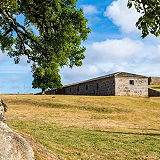
| Fortress of Santa Teresa | |
| The Fortress of Santa Teresa is a historic military fort located in Rocha, a department in southeastern Uruguay. It was built in the late 18th century by the Spanish colonial authorities to protect the region from potential invasions by Portuguese forces from Brazil. | |

| Punta Ballena | |
| Punta Ballena is a small peninsula (punta) and a resort (balneario). Punta Ballena is an important tourist attraction on the coast of RÃo de la Plata in the Maldonado Department of southeastern Uruguay. It comprises an approximately 12 kilometres (7.5 mi) long stripe of beaches and landforms and extends on both sides of Route 10. | |

| Uruguay | |
| Uruguay is a small country located in the southeastern region of South America, bordered by Brazil to the north, Argentina to the west, and the Atlantic Ocean to the south and east. Its capital and largest city is Montevideo. | |

| Palacio Salvo | |
| Palacio Salvo is a building in Montevideo, Uruguay. Finished in 1928, Palacio Salvo stands 100 m (330 ft) high with the antenna included. It was the tallest building in Latin America for a brief period. | |
