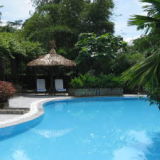
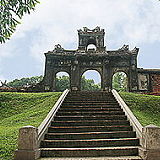
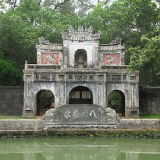
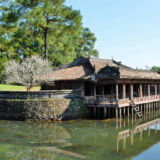
Pilgrimage Village Resort & Spa is ideally located in the quiet countryside in rustic village setting surrounding by lush tranquil gardens, yet near to famous historical landmarks. The resort embodies the subtle connection of traditional stylish and modern art concept.
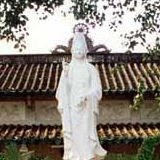
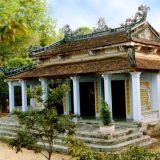
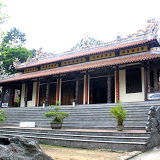
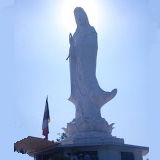
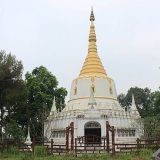
Chùa Đức Sơn is a Buddhist temple located in Hue City, Vietnam. It is also known as a special charitable center, providing a home for hundreds of orphans and underprivileged children, offering them love and attentive care from the nuns. Duc Son Pagoda is a symbol of compassion, a place that helps children overcome adversity and look towards a better future.
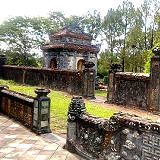
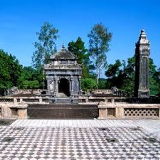
Emperor Thiệu Trị, son of Minh Mang, reigned for only seven years and did not have the opportunity to build his own mausoleum during his lifetime. After his death, his remains were temporarily kept at Long An Temple, which the Emperor himself had built in 1845. His son, Tu Duc, built this permanent mausoleum in 1848.
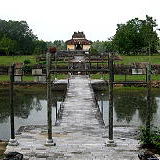
Lang Xuong Tho, also known as the Tomb of Queen Mother Tu Du, is a historic tomb located in Thuy Bang Village, Huong Thuy District, Hue, Vietnam. She was the wife of King Thieu Tri, mother of king Tu Duc, so her tomb is within King Thieu Tri's Mausoleum.
Vua Kien Phuc, whose birth name was Nguyen Phuc Ung Dang, was the 7th emperor of the Nguyen Dynasty in Vietnam. He was born on February 12, 1869, and ascended to the throne in 1883 at the age of 14. King Kien Phuc was only king for 8 months, and became the most ill-fated monarch of the Nguyen Dynasty, when he died just 15 years old - 1884.
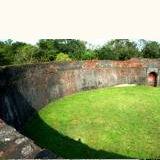
Hổ Quyền (Tiger Arena) was a place where tigers and elephants fought to the death in the style of Roman gladiatorial combat, to entertain the royal family and high-ranking guests. The Tiger Arena was built in 1830 along the southern bank of the Perfume River, about 200 meters from Long Chau Temple, where the royal war elephants were worshipped and buried.
Đan viện Thiên An (Thien An Monastery) is a religious institution located in Thuy Xuan Ward, Hue City, Vietnam. It is a Catholic monastery belonging to the Dominican Order. The monastery is situated in a peaceful and picturesque area, surrounded by lush greenery and serene scenery. It provides a place of retreat for nuns and monks, as well as a place of worship and contemplation for visitors.
Lăng Kiên Thái Vương (Mausoleum of the Prince of Kiên Thái) is located in Thủy Xuân, Huế. Nguyễn Phúc Hồng Cai (December 13, 1845 - May 15, 1876) was a prince of the Nguyen Dynasty in Vietnam. He was the father of three emperors: Kien Phuc, Dong Khanh, and Ham Nghi. Hong Cai was the twenty-sixth son of Thieu Tri, and his mother was Truong Thi Vinh.
Chùa Thiền Lâm - Theravada or chua Phat Dung - Phat nam, located in the Thuy Xuan, Hue, Vietnam, is a Zen Buddhist temple known for its peaceful ambiance and beautiful natural surroundings. Its beautiful setting and focus on meditation and mindfulness make it a place of spiritual retreat and self-reflection.
Vong Canh Hill (Đồi Vọng Cảnh) is a scenic 43m-high hill located in the North West of Hue city, Vietnam. It is situated on the banks of the Perfume River, and it offers stunning panoramic views of the surrounding area. The hill is about 7 km from the city center of Hue and is accessible by car or motorbike.
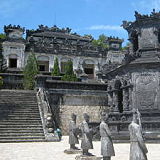
Emperor Khải Định who ruled 1916-1925, has chosen slope of Chau Chu mountain, 10 km from Hue, as the location to build his tomb (Mausoleum of Emperor Khai Dinh). The construction of the tomb was started on 1920 and lasted for 11 years.
Chùa Long Châu (Điện Voi Ré or Elephant Zoo) is a famous historical site located in Thuy Bieu, Hue, Vietnam. It is a historical relic of a herd of elephants under the Nguyen dynasty. This unique relic is the vestige of Hue ancient capital.
Duong Xuan Thuong III village, Thủy Xuân, Huế, Thành phố Huế
567 views 💖 5
Chùa Từ Hiếu was originally a small hut built in 1843, who was formerly recognized by royal authority as the monk of Giac Hoang Pagoda. In 1848, the pagoda was restored by monk Cung Ky with the help of the king's eunuchs and courtiers. Tu Hieu hence became a large pagoda.
Thuy Bieu is an ancient picturesque village located at the edge of the Perfume River, in Hue city of Vietnam. It is known for its tranquil setting, traditional architecture, and unique cultural experiences. Thuy Bieu provides a glimpse into rural Vietnamese life and offers visitors the chance to connect with local traditions and customs.
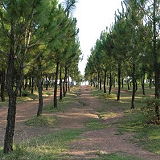
Emperor Tự Đức’s tomb is located in a narrow valley in Duong Xuan Thuong village (currently Thuong Ba village, Thuy Xuan Commune, Hue City). It is one of the most beautiful works of royal architecture of the Nguyen dynasty. The tomb lies in a boundless pine forest, 8 km from Hue. Its construction started in December 1864 and finished in 1867.
Emperor Đồng Khánh was the ninth emperor of the Nguyen Dynasty of Vietnam. He reigned three years between 1885 and 1889. He was born on March 20, 1864, in Hue, the capital city of Vietnam at the time and was another adopted son of Tu Duc who usurped the throne shortly after the French gained control of Hue. The tomb of Emperor Dong Khanh is the smallest.