Greece is a country in Southeast Europe. It is situated on the southern tip of the Balkans, and is located at the crossroads of Europe, Asia, and Africa. The country consists of nine traditional geographic regions, and has a population of approximately 10.7 million. Athens is the nation's capital and largest city, followed by Thessaloniki.
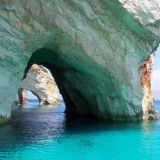
The magnificent Blue Caves are in the north of the Greek Ionian island of Zakynthos. the blue caves are only accessible by the sea. The biggest cave is called Kianoun, and there are, in general terms, many boats available for rent in the town port for tourists to be able to get to the blue caves.
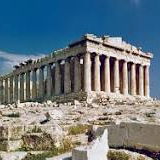
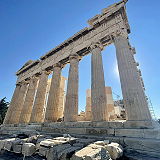
The Parthenon is a former temple on the Athenian Acropolis, Greece, that was dedicated to the goddess Athena during the fifth century BC. Its decorative sculptures are considered some of the high points of Greek art, an enduring symbol of Ancient Greece, democracy and Western civilization. The construction began in 447 BC when the Athenian Empire was at the height of its power.
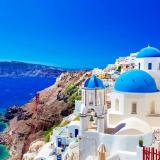
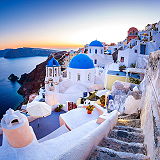
Santorini is an island in the southern Aegean Sea, about 200 km (120 mi) southeast from the Greek mainland. It is the largest island of a small, circular archipelago. It has an area of approximately 73 km2 (28 sq mi) and a 2011 census population of 15,550.
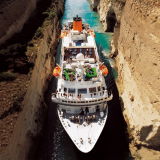
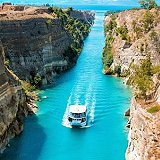
The Corinth Canal is a man-made waterway located in Greece, which connects the Gulf of Corinth in the Ionian Sea with the Aegean Sea. It cuts through the narrow isthmus of Corinth and separates the Peloponnese peninsula from the mainland of Greece.
Athens is the capital city of Greece. With a population close to four million, it is the largest city in Greece. Athens dominates and is the capital of the Attica region and is one of the world's oldest cities, with its recorded history spanning over 3,400 years and its earliest human presence beginning somewhere between the 11th and 7th millennia BC.
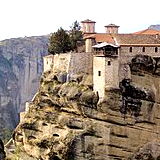
Meteora is a unique and breathtaking rock formation located in central Greece. It is famous for its monasteries perched atop towering rock pillars, creating a stunning and otherworldly landscape. Meteora is located in the Thessaly region of central Greece, near the town of Kalambaka. It's situated in a valley surrounded by towering rock formations.
Crete is the largest island in Greece, and the fifth largest one in the Mediterranean Sea. Here, you can admire the remnants of brilliant civilizations, explore glorious beaches, impressive mountainscapes, fertile valleys and steep gorges, and become part of the island’s rich gastronomic culture.
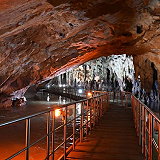
The Aggitis River Cave, also known as the Maara Cave, is a stunning natural attraction located near the village of Aggitis in the Drama region of northern Greece. It is one of the longest river caves in the world and a significant geological and tourist site. The cave is approximately 21 kilometers long, though only a portion of it (about 500 meters) is accessible to visitors.
The Rodopi Mountain Range National Park in Greece, also known as the Rhodopes National Park, is a vast and biodiverse area located in northern Greece along the border with Bulgaria. This protected area is part of the larger Rhodope Mountains, known for their rich ecosystems, cultural significance, and stunning landscapes.
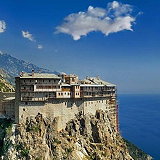
The Simonos Petras Monastery, also known as Simonopetra, is one of the most striking monasteries on Mount Athos, Greece. Built on a steep cliff about 330 meters above the Aegean Sea, this Eastern Orthodox monastery seems almost to float above the water, creating an unforgettable sight with its dramatic, cliffside architecture. Founded in the 13th century by Saint Simon the Myrrhbearer, the monastery is dedicated to the Nativity of Christ.
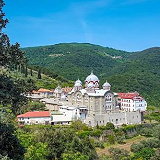
The Holy Monastery of Hilandar, located on the Athos Peninsula in Greece, is one of the twenty Eastern Orthodox monasteries on Mount Athos. It holds immense significance, particularly for the Serbian Orthodox Church, as it was founded by Saint Sava and his father, Saint Simeon, the medieval ruler of Serbia, in 1198. Known for its deep historical and spiritual roots, Hilandar Monastery has been a focal point of Serbian culture and Orthodoxy for over 800 years.
The Acropolis Museum is an archaeological museum focused on the findings of the archaeological site of the Acropolis of Athens. The museum was built to house every artifact found on the rock and on the surrounding slopes, from the Greek Bronze Age to Roman and Byzantine Greece. The Acropolis Museum also lies over the ruins of part of Roman and early Byzantine Athens.
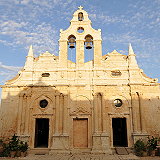
The Arkadi Monastery is an Eastern Orthodox monastery, situated on a fertile plateau 23 km (14 mi) to the southeast of Rethymno on the island of Crete in Greece. It is one of the Orthodox monasteries that accentuate the catholic and ecumenical character of the Church. Each year the monastery welcomes and hosts visitors and pilgrims coming here from various countries and faraway civilizations.
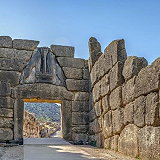
The archaeological site of Mycenae, located in the northeastern part of the Peloponnesian Peninsula in Greece, is one of the most significant historical sites from the Late Bronze Age. It flourished during the second millennium BCE and is often considered the center of the Mycenaean civilization, which greatly influenced Greek culture and mythology.
The Corinth Canal is an artificial canal in Greece that connects the Gulf of Corinth in the Ionian Sea with the Saronic Gulf in the Aegean Sea. It cuts through the narrow Isthmus of Corinth and "separates" the Peloponnese peninsula from the rest of the Greek mainland. The canal was dug through the Isthmus at sea level and has no locks.
Emporio castle is one of the five Venetian castles on the island of Santorini. Its main purpose was to provide security for the town’s inhabitants during the frequent pirate raids of the time. Nearby, there is another fortification, the Goulas Tower, once connected to the castle by a secret tunnel.
The actual Heart of Santorini is a recently discovered attraction that has been drawing increasing amounts of attention! It is a heart-shaped hole in a rock, through which you can see the Aegean Sea, the sky, and the volcano.
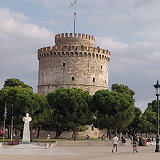
The White Tower of Thessaloniki is a monument and museum on the waterfront of the city of Thessaloniki. Τhe White Tower has housed the new permanent exhibition on Thessaloniki from the age of its founding in 316/15 B.C. to the present. The exhibition summarily presents aspects of the city’s history, which is distinguished by its long and unbroken historical presence.
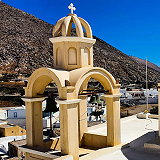
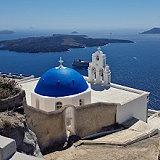
The Three Bells of Fira, officially known as The Catholic Church of the Dormition, is a Greek Catholic church on the island of Santorini. The church is known for its blue dome, three bells and views. The building is located in the town of Fira, directly above the cliffs which dominate western Santorini.