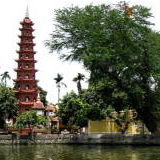
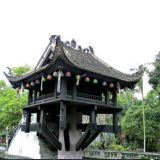
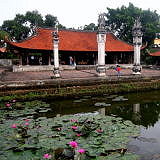
Đền Quán Thánh (Quan Thanh temple) is located near West Lake, Ba Dinh District, Ha Noi. Built during the reign of King Ly Thai To (1010-1028) and renovated many times, the temple is also called Tran Vu temple, since it is dedicated to Huyen Thien Tran Vu (Guardian of the North of the Country).
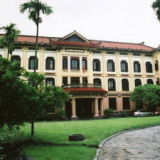
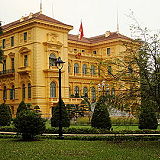
Bảo tàng Mỹ thuật Việt Nam (Vietnam National Fine Arts Museum) exhibits in great detail the history of fine arts of Vietnam. It displays comprehensive collections with more than 2,000 items.
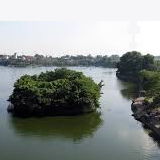
Hồ Trúc Bạch (Truc Bach Lake) is a picturesque lake located in the Ba Dinh district of Hanoi, the capital city of Vietnam. It is adjacent to the larger West Lake (Ho Tay) and is connected to it by a small canal. It is a relatively small but historically and culturally significant body of water.
Ba Đình is one of the four original urban districts (quan) of Hanoi, the capital city of Vietnam. The district currently has 14 wards, covering a total area of 9.21 square kilometers. As of 2019, there were 221,893 people residing in the district, the population density is 24,000 inhabitants per square kilometer.
19c Hoàng Diệu, Điện Biên, Ba Đình, Hà Nội, Vietnam
509 views 💖 4
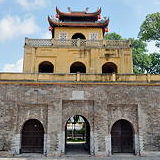
Hoàng Thành Thăng Long, also known as the Thang Long Imperial Citadel, is a historic site located in the Ba Dinh district of Hanoi, the capital city of Vietnam. It holds great significance in Vietnamese history and culture and has been recognized as a UNESCO World Heritage Site.
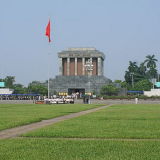
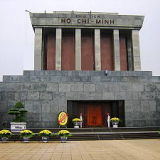
Ho Chi Minh Mausoleum (Lang Chu Tich Ho Chi Minh) is a mausoleum in Ba Dinh, Hanoi, Vietnam, where the embalmed body of revolutionary leader and President Ho Chi Minh is kept. It is a large building located in the center of Ba Dinh Square, where Ho, Chairman of the Workers' Party of Vietnam from 1951 until his death in 1969, read the Declaration of Independence on 2 September 1945, establishing the Democratic Republic of Vietnam. It is open to the public every morning except Monday.