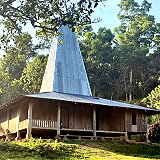
Sumba is an Indonesian island, part of the Lesser Sunda Islands archipelago, located in eastern Indonesia and administratively belonging to the East Nusa Tenggara province. Its population in 2025 was 852,832, up from 779,049 in 2020.
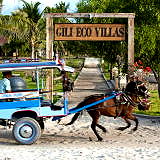
The Gili Islands are a group of three small islands located off the northwest coast of Lombok, an island in the West Nusa Tenggara province of Indonesia. These islands are renowned for their stunning natural beauty, crystal-clear waters, and vibrant coral reefs. The Gili Islands are a popular destination for travelers seeking to experience the beauty of Indonesian marine life and relax on pristine beaches.
Turpuk Sihotang, Harian, Samosir Regency, North Sumatra 22396, Indonesia
115 views 💖 1
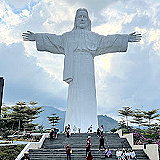
On September 19, 2024, Indonesia inaugurated the world's tallest statue of Jesus Christ on Sibeabea Hill in Samosir district, North Sumatra province, overlooking Lake Toba. Standing 61 meters tall, the statue offers panoramic views of Lake Toba. It is 20 meters taller than the 39.6-meter-tall Christ the Redeemer statue in Brazil. The project aims to boost tourism in the region.
Ayeyarwady Region is a first-level administrative division of Myanmar, located in southwestern Myanmar on the Ayeyarwady River delta. The region's population was 6,184,829 in 2914. The highest elevation is Taungni, at 1,225 meters (4,019 ft). Ayeyarwady is known for its lush green landscapes and abundant wildlife. The capital of the Ayeyarwady Region is Pathein.
Tanintharyi Region is a first-level administrative division of Myanmar, encompassing the long, narrow southern part of the country on the northern Malay Peninsula. It includes numerous offshore islands, the large Mergui Archipelago in the southern and central coastal areas, and the smaller Moscos Archipelago off the northern coast. The regional capital is Dawei. The region's population was 1,406,434 in 2014.
Dawei is a city in southeastern Myanmar and the capital of Tanintharyi region, situated on the eastern bank of the Dawei River Canal. The city had a population of 125,605 in 2014. Dawei is a seaport at the mouth of the Dawei River, 30 km from the Andaman Sea. Dawei is truly a hidden gem in southern Myanmar, boasting stunning coastal scenery and a unique, captivating local culture.
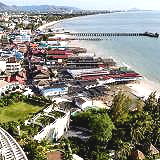
Hua Hin is a seaside resort town in Thailand, located about 200 kilometers south of Bangkok. It is known for its long sandy beach, upscale hotels, golf courses, and royal residences.
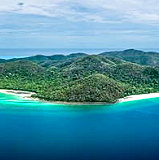
Ko Khram Yai Island is located in Bangkok Bay, about 24 km south-southwest of Pattaya. It is the largest of Thailand's eastern coastal islands and the largest island in the bay. Ko Khram is heavily forested and uninhabited. The island is 5.7 km long and approximately 4 km wide at its maximum. Its coastline is formed by rugged cliffs interspersed with white sandy beaches.
Na Chom Thian, Sattahip District, Chon Buri 20250, Thailand
13 views 💖 1
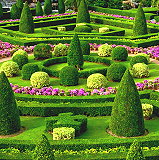
Nong Nooch Pattaya Botanical Garden is a 500-acre (2.0 km²) botanical garden and a popular tourist destination in Chonburi Province, Thailand. It is also a major scientific center specializing in cycads, with its own cycad gene bank. Nong Nooch is the largest botanical garden in Southeast Asia, having collected and cultivated over 18,000 plant species.
Sam Roi Yot, Sam Roi Yot District, Prachuap Khiri Khan, Thailand
10 views 💖 1
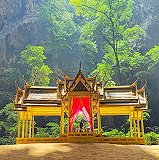
Phraya Nakhon Cave is located in Khao Sam Roi Yot National Park, Hua Hin, Prachuap Khiri Khan Province, Thailand. Phraya Nakhon Cave is divided into two chambers. The first chamber contains the Kuha Karuhas pavilion. The second chamber, less frequently visited by tourists, is notable for its natural stalactites and stalagmites.
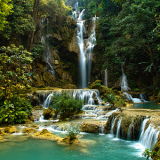
The Kuang Si Falls, sometimes spelled Kuang Xi or known as Tat Kuang Si Waterfalls, is a three tier waterfall about 29 kilometres south of Luang Prabang. These waterfalls are a favourite side trip for tourists in Luang Prabang.
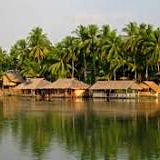
The Si Phan Don is a riverine archipelago located in the Mekong River, Champasak Province in southern Laos. Si Phan Don is characterised by numerous islands, half of which are submerged when the Mekong River is in flood.
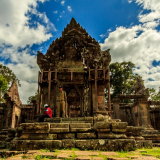
Preah Vihear Temple, also known as Prasat Preah Vihear, is an ancient Hindu temple complex located atop a hill in the Dangek Mountains on the border between Cambodia and Thailand. It is located in Cambodia's Preah Vihear Province, near the town of Sra'em.
Ban Lak 40, Road 23, Paksong District, Champasak Province, Laos
323 views 💖 1
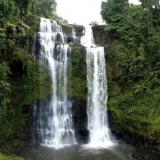
Tad Gneuang Waterfall is a beautiful natural attraction located in the southern part of Laos, in Champasak Province. It is located within the Dong Hua Sao National Protected Area, which is known for its rich biodiversity and stunning natural landscapes. Tad Gneuang Waterfall is a 40 metre tall waterfall on the Bolaven Plateau easily accessible on a day trip from the large town of Pakse.
Prasat Ta Muan Thom, also known as Prasat Ta Muen Thom, is an ancient Khmer-Hindu temple located near the Thai-Cambodian border in Kouk Mon, Oddar Meanchey Province, Cambodia . Its Khmer name translates to "Great Temple of Grandfather Chicken". The temple complex has been a point of contention between Thailand and Cambodia, with both countries claiming it.
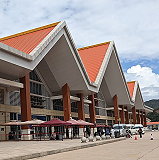
Boten Station is a railway station in Boten, Laos. It is the northernmost intermediate stop and the final stop in Laos on the Boten-Vientiane railway line, a 1,035 km standard-gauge railway connecting Kunming in Yunnan Province, China, with Vientiane, the capital of Laos.
Preah Vihear is one of the nine provinces of Cambodia. Its northern border is part of the international border between Cambodia and Thailand and Laos. The province's population was 249,973 in 2024. The provincial capital is Preah Vihear. The majestic temples of Preah Vihear are among the most iconic tourist attractions in the world.
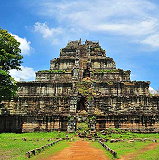
Koh Ker is a remote archaeological site in northern Cambodia about 120 kilometres (75 mi) away from Siem Reap and the ancient site of Angkor. It is a jungle filled region that is sparsely populated. More than 180 sanctuaries were found in a protected area of 81 square kilometres (31 sq mi).
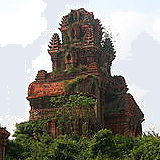
Tháp Dương Long is a complex of three Cham towers situated close together on a high mound in Binh An, Gia Lai, Vietnam. The towers were built in the late 12th century, during the most prosperous period of Cham culture. Duong Long Tower consists of three towers: the central tower is 39 meters high, while the other two are 32 meters high.
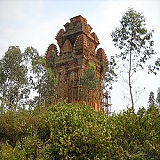
Tháp Thủ Thiện is an ancient Cham tower located on the southern bank of the Con River, in Thu Thien village, Tay Son commune, Gia Lai province. The tower was built around the 11th century. It is a square-shaped tower structure, consisting of a main body and three upper levels, resembling the base of a tower but on a smaller scale.
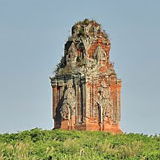
Tháp Chăm Cánh Tiên, also known as tháp Đồng or tháp Con Gái, is a tower located in the middle of the old Do Ban citadel, now in An Nhon, Gia Lai, Vietnam. Built around the 12th century, this structure coincided with the flourishing period of the Champa kingdom. It stands nearly 20 meters tall, built on a square base with four tiers that gradually decrease in size towards the top.
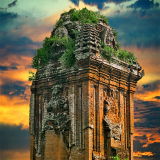
Tháp Phú Lốc, also known as tháp Vàng, is a historical monument located in An Nhơn Bắc, Gia Lai, which is in the central part of Vietnam. Phu Loc Tower is a Cham architectural structure built by the Cham people who once lived in the area. The tower is made of brick, has a square base, and multiple levels. The tower features intricate carvings depicting Hindu deities and mythological scenes.
Bình Định is a ward of Gia Lại, Vietnam. It is located in Vietnam's South Central Coast region. The majority of Binh Dinh ward is covered by mountains or hills. Elevations range from 0 at the coast to around 1200 meters above sea level. It had a population of 42,768 in 2024.
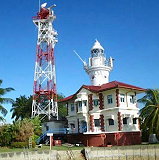
Sultan Shoal Lighthouse is a lighthouse on a small island in the Singapore Strait, southwest of mainland Singapore. It marks a navigational hazard in waters used by ships approaching Singapore. The Structure includes A cylindrical masonry tower, painted in red-and-white bands, attached to a keeper’s dwelling with the Height of About 18 metres
Koh Ta Kiev is the largest island in a small group of Cambodian islands, located 4 km from Otres Beach, Sihanoukville. The island, largely covered by forest, covers an area of approximately 6.70 km² (3 square miles) and is mostly flat with a few hills. There is also a small fishing village on the eastern side of the island. Endless stretches of beach attract many visitors.
4/126 D. Nguyễn Hữu Cảnh, Thanh Thủy, Huế, Vietnam
336 views 💖 5
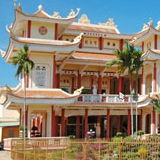
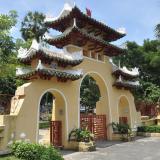
Chùa Diệu Viên is a Buddhist temple located in Thanh Thuy, Hue, Vietnam. It is a place of worship and spiritual practice, reflecting the rich Buddhist heritage of the region. The pagoda is renowned for its serene atmosphere, traditional architecture, and significant cultural importance within the local community.
Hương So is an area in Hue city, Vietnam. It is located in the northeast of Hue city, about 5 km from the city center. The population in 2022 was 18,225 people.
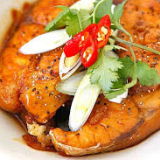
Papaya Papa – A rooftop restaurant, bar & club in Ho Chi Minh City specializing in light, healthy, and naturally delicious traditional Northern Vietnamese cuisine.
The Great Poet Nguyen Du Memorial Area (Khu lưu niệm Đại thi hào Nguyễn Du 1765-1820) is a complex of relics related to the life and career of the Great Poet and the Nguyen Tien Dien family. The relic sites are distributed in Tien Dien commune , Nghi Xuan district, Ha Tinh province. He is most known for writing the epic poem The Tale of Kieu.
Chua Buu Nghiem is a Buddhist temple located in the Duy Tan neighborhood of Pleiku city, which is the capital of Gia Lai province in the Central Highlands region of Vietnam. Pleiku is located approximately 550 kilometers (340 miles) north of Ho Chi Minh City.
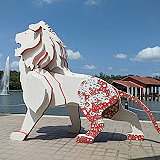
The Singapore Discovery Centre is an educational and tourist attraction managed by the Singapore Ministry of Defence, located in Jurong West, Singapore. The centre features exhibits showcasing Singapore's history as well as a vision of the future. It also offers a variety of engaging activities, from relaxing family games to team-building activities.
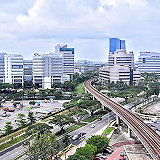
Jurong is a strategically important area located at the southwesternmost point of Singapore's Western Region. The area is notable for its expansive Jurong Lake Gardens, lakeside promenades, and green spaces. Jurong also includes several offshore islands, among them Pulau Damar Laut and Pulau Samulun.
Bedok is a planned residential area and town located within the Tanah Merah Geographic Area along the southeastern coast of East Singapore. It is known for its vibrant culinary scene, rich history as an old fishing village, and popular outdoor recreational areas. Bedok is the second most populous planned area in the country, with 274,360 residents in 2025.
Bedok Pier is a popular fishing pier located in Bedok, Singapore. The 300-meter-long pier is renowned for its stunning ocean views and is a favorite destination for fishing, relaxing, and enjoying outdoor activities. The pier offers a tranquil environment where visitors can unwind while admiring the Singapore Strait.
The Singapore City Gallery is a prominent urban planning exhibition center located within the Urban Development Authority building in Singapore. It comprehensively showcases Singapore's achievements in urban development, planning, and architecture. The gallery presents detailed models, maps, and artifacts illustrating the city's development process, future plans, and sustainable development initiatives.
Ubud is a town in Gianyar district, Bali, Indonesia. It has been an important center of Balinese culture and local spirituality, attracting artists and tourists for nearly a century. Ubud remains one of the best places to visit temples, admire Balinese art, watch dances and cultural performances, as well as practice yoga and pursue a healthy lifestyle.
Vientiane Prefecture is a prefecture of Laos, located in northwestern Laos, near the border with Thailand. The capital city, Vientiane, is within the prefecture. The prefecture was established in 1989, when it separated from Vientiane Province. The estimated population of the prefecture in 2015 was approximately 820,000 people.
Di tích Lịch sử Thành cổ Quảng Trị, also known as Quang Tri Ancient Citadel, is an ancient fortress located in Quang Tri Province, Central Vietnam. Built in 1824 during the Nguyen Dynasty, this fortress once served as a military stronghold to protect Vietnam's border against invading forces.
Núi Bà Đen, also known as Black Virgin Mountain, is a historical and beautiful mountain located in Tay Ninh province, Viet Nam covering an area of more than 24 km2.
Lang Son is a province in northern Vietnam. Its capital is also called Lang Son, which is astrategically important town at the border with Chinaand is 137 kilometres northeast of Hanoi connected by rail and road.
Lao Cai is a province of the mountainous Northwest region of Vietnam bordering the province of Yunnan in China. The province covers an area of 6,383.9 square kilometres and as of 2008 it had a population of 602,300 people. Lao Cai is also the capital of Lao Cai province and shares border with the city of Hekou, in the Yunnan province of Southwest China.