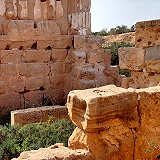
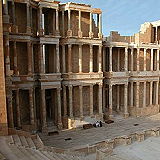
The ancient city of Sabratha, located in present-day Sabratah, Libya, was one of the major cities of the Roman province of Tripolitania. Founded by the Phoenicians in the 5th century BC, Sabratha became an important trading center, particularly for the exchange of goods between the Mediterranean and inland Africa.
The Sabratha Museum displays artifacts unearthed from the archaeological site, including sculptures, mosaics, pottery, and other relics from the Greco-Roman period. The museum's collection includes Roman mosaics depicting mythological scenes, statues and busts of Roman and local figures, and objects from the daily life and religious activities of the ancient city.
Sabratah, in Libya's Zawiya district, is the westernmost of the ancient "three cities" of Roman Tripolis, along with Oea and Leptis Magna. From 2001 to 2007, it was the capital of the former Sabratha wa Sorman district. It lies on the Mediterranean coast, approximately 70 km (43 mi) west of modern Tripoli.
The ancient Sabratha Theatre is one of the most outstanding and best-preserved Roman architectural monuments in North Africa. Located in the ancient city of Sabratha, Libya, in the Roman province of Tripolitania, the theatre dates from the 2nd century AD, during the reign of Emperor Septimius Severus, who was born in nearby Leptis Magna.
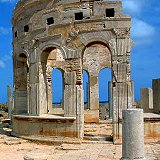
Lepics Magna, also known by various other names in antiquity, was an important city of the Roman Carthaginian and Libyan empires located at the mouth of the Wadi Lebda River on the Mediterranean Sea. Founded as a Punic settlement before 500 BC, the city underwent significant expansion under the Roman Emperor Septimius Severus (reigned 193–211), who was born there.
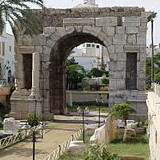
The Arch of Marcus Aurelius is an ancient Roman triumphal arch located in Tripoli, Libya. This well-preserved monument, constructed in AD 165, was dedicated to the Roman emperor Marcus Aurelius and his co-emperor Lucius Verus to commemorate their victories over the Parthians and other military campaigns in the East.
The Saraya Museum, also known as the Red Castle Museum, is a major historical and cultural museum located in the Red Castle in Tripoli, Libya. It is one of Libya's most important museums, housing a vast collection of artifacts that span thousands of years of the region's history.
Tripoli is the capital city and the largest city of Libya. Tripoli was founded in the 7th century BC by the Phoenicians, who named it Oea. Due to the city's long history, there are many sites of archaeological significance in Tripoli. Its population was 1.183 million people in 2023.
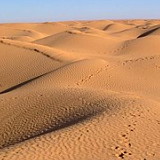
The Grand Erg Oriental (English: 'Great Eastern Sand Sea') is a large erg or "field of sand dunes" in the Sahara Desert. Situated for the most part in Saharan lowlands of northeast Algeria, the Grand Erg Oriental covers an area some 600 km wide by 200 km north to south. The erg's northeastern edge spills over into neighbouring Tunisia.
Libya is a country located in North Africa. Libya features diverse landscapes, including the vast Sahara Desert, the Mediterranean coastline, and a range of mountainous areas. The country’s terrain is mostly barren with occasional oases. Islam, specifically Sunni Islam, is the dominant religion. Islamic traditions and cultural practices play a significant role in daily life. Its population was 7,361,263 in 2024.