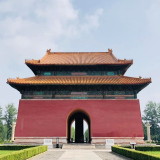
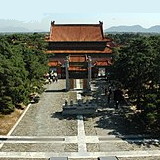
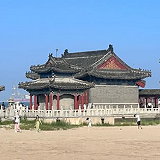
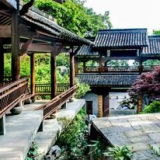
Xianling Tomb of the Ming Dynasty (tomb of Emperor Hongxi, the fourth emperor of the Ming Dynasty of China). The Ming tombs are a collection of mausoleums built by the emperors of the Ming dynasty of China.
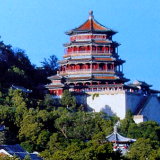
The Summer Palace is a beautiful imperial garden located in the Haidian district of Beijing, China. It was originally built in the 18th century as a summer retreat for the Qing Dynasty emperors and was later restored and expanded in the 19th century.
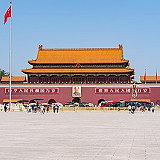
Tiananmen Square, located in the heart of Beijing, China, is one of the largest public squares in the world, covering an area of about 109 acres (44 hectares). It is a symbol of China's national identity and has been the site of numerous significant historical events.
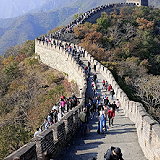
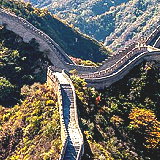
Mutianyu Great Wall has a long history and a splendid culture. Located 70 kilometers away from the center of Beijing, it is one of the famous sections of the Great Wall in Beijing and represents the essence of the Ming Dynasty's Great Wall. Mutianyu Great Wall is renowned both domestically and internationally and is praised as an outstanding section of the Great Wall.
Yanqing District is a district of Beijing, located northwest of the city center. The district had a population of 345,671 in 2020. Yanqing is a summer resort and agricultural center of Beijing. Notable cultural and historical sites include the Badaling Great Wall and the Guyaju Caves (ancient cliff dwellings).
The Badaling Great Wall is located approximately 80 km northwest of downtown Beijing, in Badaling town, Yanqing district, Beijing. The highest point in Badaling is Beibalou, reaching about 1,015 meters above sea level. The section of the wall running through this area was built in 1504 during the Ming Dynasty, along with a military outpost reflecting the strategic importance of this location.
Tangshan is a coastal, industrial city at the provincial level located in northeastern Hebei Province. A section of the Great Wall of China runs through Tangshan for approximately 220 kilometers. With its 29 famous passes, the winding walls bear witness to the ingenuity of the Ming Dynasty. The city's population was 7,717,983 in 2020.
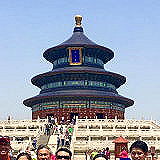
The Temple of Heaven is a complex of imperial Confucian religious architecture located southeast of central Beijing. The complex was once visited by the Ming Dynasty emperors and later restored by the Qing Dynasty to perform annual prayers for bountiful harvests and other seasonal rituals.
Dongcheng is a district of Beijing. It covers the eastern half of Beijing's central metropolitan area. Dongcheng includes many of Beijing's major cultural attractions, such as the Forbidden City and the Temple of Heaven. The district's population was 708,829 in 2020.
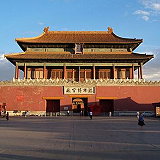
The Forbidden City is a royal palace complex located in the heart of Imperial City, central Beijing, China. It served as the residence of 24 emperors of the Ming Dynasty until the end of the Qing Dynasty, and was the center of Chinese political power for over 500 years, from 1420 to 1924. Currently, the palace is managed by the Palace Museum.
The Dongqing Tombs are a royal tomb complex of the Qing Dynasty located in Jinghua County, Tangshan City, Hebei Province. It is the largest, most complete, and best-preserved tomb complex still existing in China. The Dongqing Tombs are one of two tomb complexes dedicated to the emperors, empresses, and concubines of the Qing Dynasty. The other is the Xiqing Tombs.
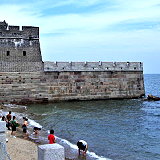
Laolongtou, also known as Old Dragon's Head, is where the easternmost section of the Ming Dynasty Great Wall meets the Bohai Sea at Shanhaiguan. It is part of the Shanhaiguan Pass Great Wall defense system, which includes mountains, sea, plains, and towns.
Qinhuangdao is a port city located on the northern coast of Hebei Province, China, on the Bohai Sea, the innermost bay of the Yellow Sea. According to the 2020 national census, the city's population was 3,136,879. Famous for its beautiful coastline and attractions related to the Great Wall of China, Qinhuangdao is an attractive tourist city, rich in history and with fresh air.
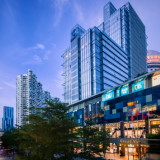
Shenzhen is a major city in Guangdong Province, China. It forms part of the Pearl River Delta megalopolis, bordering Hong Kong to the south, Huizhou to the northeast, and Dongguan to the northwest. It holds sub-provincial administrative status, with powers slightly less than those of a province.
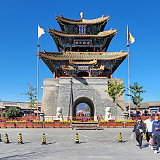
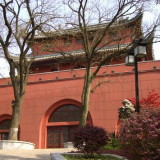
The Drum Tower in Nanjing was first built in the 15th year of the Hongwu era of the Ming Dynasty (1382). The Drum Tower is a beautiful two-story classical structure situated amidst a charming and tranquil garden, used for telling the time.
Hangzhou is the capital and most populous city of Zhejiang, People's Republic of China. It sits at the head of Hangzhou Bay, which separates Shanghai and Ningbo. Hangzhou Prefecture had a registered population of 10,360,000 in 2019.
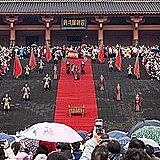
Hengdian Film Studio, commonly known as "Chinawood", is a film studio located in Hengdian, a town in Dongyang, Zhejiang Province, China. It is one of the largest film studios in the world, serving as a production base for period dramas and Chinese movies, as well as a giant theme park with elaborate sets such as the Qin Dynasty Palace and Song Dynasty Old Street.
The Mogao Caves, also known as the Mogao Grottoes or the Caves of the Thousand Buddhas, are a renowned UNESCO World Heritage site located near the city of Dunhuang in Jiuquan, Gansu Province, China. These caves are famous for their exceptional Buddhist art and are one of the most significant archaeological and cultural treasures in China.
The Kumbum Monastery, also known as Ta’er Temple, is a popular Tibetan Buddhist monastery located in the city of Xining, Qinghai Province, China. It is one of the six great monasteries of the Gelug sect of Tibetan Buddhism and is renowned for its historical and cultural significance.