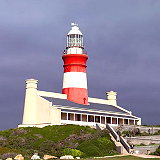
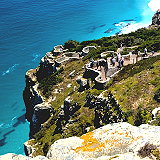
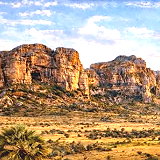
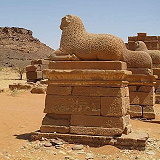
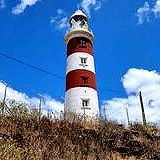
Cape Agulhas is a rocky headland in the Western Cape province of South Africa. It is the southernmost point of South Africa, the geographically southernmost point of Africa, and the starting point of the traditional dividing line between the Atlantic and Indian Oceans according to the International Hydrographic Organization. A famous red and white lighthouse, still in operation, stands here, guiding ships.
The Cape of Good Hope is a rocky headland on the Atlantic coast of the Cape Peninsula in South Africa, about 50-70 km south of Cape Town. It is famous for its majestic cliffs, turbulent seas, and its important historical role in the European-Asian sea routes. Here you can find 1100 endemic plant species and 250 different bird species, as well as Cape mountain zebras, ostriches, antelopes, and turtles.
Ihorombe is a region of Madagascar. Its population in 2018 was 418,520, and its capital is Ihosy. The region is rich in natural beauty and offers opportunities for adventure activities. It is known for its rugged landscapes with majestic rock formations and sparse vegetation.
The Meroë Pyramids are a large complex of Nubian pyramids, comprising three burial sites near the ancient city of Meroë. Dating from the late Kush Kingdom period (3rd century BC – 4th century AD), the Meroë Pyramids served as burial places for Kush kings, other members of the royal family, and important officials and dignitaries.
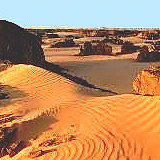
The Algerian Desert is a desert located in central North Africa, within Algeria, and is part of the Sahara Desert. It covers more than 90% of Algeria's total land area. In 2018, it had a population of 3,600,000 people, representing 10.5% of Algeria's population. From the vibrant festivals of Djanet to the enchanting Timimoun oasis, the Algerian Desert offers many fascinating destinations to explore its wondrous landscapes.
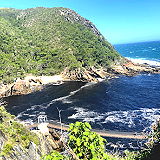
The Storms River estuary suspension bridge is located in the Storms River estuary area of Tsitsikamma National Park, along the Garden Route in South Africa's Eastern Cape province. It is surrounded by spectacular coastal scenery, with majestic cliffs, lush forests, and the crashing waves of the Indian Ocean.
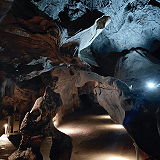
The Cango Caves, located near the town of Oudtshoorn in South Africa's Western Cape province, are a prominent natural attraction known for their extensive network of chambers and limestone formations. The caves were discovered in the late 18th century by a local farmer. Formed from Precambrian limestone, the caves feature a variety of stalactites and stalagmites, including stalagmites, stalactites, and spiral stalactites.
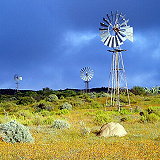
The Northern Cape is the largest and least densely populated province in South Africa. Its highest elevation is 2,156 m (7,073 ft). The population was 1,355,629 in 2022. The Northern Cape boasts expansive skies, golden sand dunes, lush vineyards, two major rivers, and two ancient deserts, all blending together in a breathtaking landscape.
The Eastern Cape Province is one of the nine provinces of South Africa. The population in 2022 was 7,225,784. Its capital is Bhisho, and its largest city is Gqeberha. The Eastern Cape is incredibly diverse, ranging from ancient primary forests and expansive valleys to rugged coastal cliffs and an 800 km (497 mile) coastline stretching from Tsitsikamma to the subtropical Wild Coast.
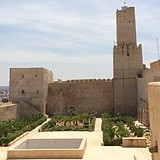
The Ribat of Sousse is a historical site located in the city of Sousse, Tunisia. It is a fortified monastery or fortress that dates back to the 9th century and is considered one of the best-preserved examples of Islamic military architecture in the Mediterranean region.
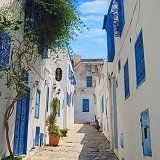
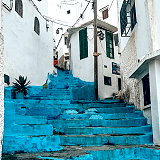
Sidi Bou Said is a town in northern Tunisia located about 20 km northeast from the capital, Tunis. The town itself is a tourist attraction and is known for its extensive use of blue and white. It can be reached by a TGM train, which runs from Tunis to La Marsa. Its population was 6,000 in 2023.
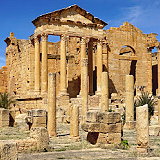
Sbeitla is a small town in central-western Tunisia, 250km from Tunis. It is famous for its unique Roman ruins and the Capitol, which includes not one but three temples dedicated to Minerva, Jupiter, and Juno, the patron goddesses of Rome.
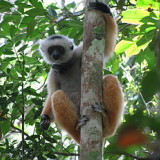
Andasibe-Mantadia National Park is a 155 square kilometre protected area, located about 150 km east of Antananarivo. The park consists principally of primary growth forest in Alaotra-Mangoro Region in eastern Madagascar.
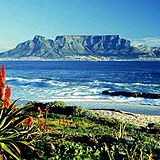
Cape Town is the legislative capital of South Africa. It is the country's oldest city and home to the South African Parliament. Cape Town is the country's second-largest city by population, with 433,688 in 2011, after Johannesburg, and the largest city in the Western Cape province. Its highest elevation is 1,590.4 m (5,218 ft).
Western Cape is a province of South Africa, located on the southwestern coast of the country. It is the third most populous province, with 7,433,020 inhabitants in 2022. The highest elevation is 2,325 m (7,628 ft). The capital is Cape Town. The province stretches approximately 400 km (250 mi) north along the Atlantic coast and approximately 500 km (300 mi) east along the southern coast of South Africa (south of the Indian Ocean).
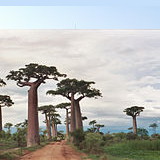
The Avenue of Baobabs, or Baobab Alley, is a prominent cluster of Grandidier baobab trees. These baobab trees grow along the dirt road between Morondava and Belon'i Tsiribihina in the Menabe region of western Madagascar.
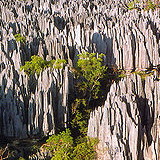
Tsingy de Bemaraha National Park is a unique and spectacular conservation area located in western Madagascar. It is renowned for its distinctive limestone formations, rugged landscapes, and rich biodiversity. The national park focuses on two geological formations: the Greater Tsingy and the Lesser Tsingy.
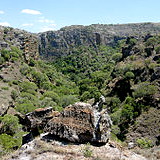
Isalo National Park is a national park located in the Ihorombe region of Madagascar. It features a landscape of sandstone formations eroded by wind and water, creating rocky outcrops, plateaus, vast plains, and canyons up to 200 meters deep.
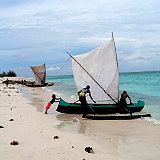
Toliara is a city in southern Madagascar. It is the capital of the Atsimo-Andrefana region. The city had a population of 168,758 in 2018. As a port city, Toliara serves as a major import and export center for commodities such as sisal, soap, hemp, cotton, rice, and peanuts.
The Roman ruins of Timgad are a notable archaeological site located near the modern town of Timgad in northeastern Algeria. Founded around 100 AD by Emperor Trajan, Timgad was originally a Roman colonial town designed to serve as a military settlement and a Roman cultural and administrative center in North Africa.
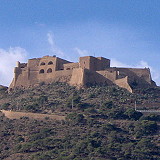
Santa Cruz Fort is one of the three forts in Oran, the second largest port city of Algeria. The three forts are connected by tunnels. Fort Santa Cruz was built between 1577 and 1604 by the Spaniards on the Pic d’Aidour above Gulf of Oran in the Mediterranean Sea, at an elevation of above 400 metres (1,312 ft). In 1831, the French occupied Oran and the fort.
Antsirabe is the third largest city in Madagascar and the capital of the Vakinankaratra region, with a population of 265,018 in 2014. Antsirabe is a charming "resort town" surrounded by volcanoes. With its fresh air and cool climate year-round, Antsirabe is an ideal location for family vacations or trips with friends.
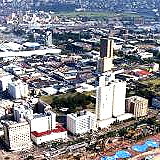
Durban is the third most populous city in South Africa, after Johannesburg and Cape Town, and the largest city in the province of KwaZulu-Natal. Its population was 595,061 in 2011. Durban embodies warmth and hospitality, from its friendly people of all races and faiths to its spicy cuisine and tropical climate.
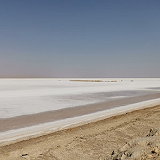
Chott el Djerid is a vast salt lake located in southern Tunisia. It is one of the largest salt flats in the Sahara Desert, spanning approximately 11,000 square kilometers. The lake is famous for its pristine white salt surface stretching to the horizon, creating a surreal and magical landscape.
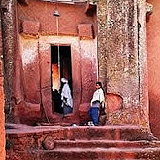
Biete Gabriel-Rufael is an underground church carved from a single block of rock, located in Lalibela, Ethiopia. This Orthodox church was built during the Kingdom of Axum. Its architecture suggests its original function may have been a fortified royal residence or an administrative building before being consecrated as a church, with its massive walls, few doorways, and tall, defensive exterior.
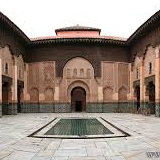
The Al-Attarine Madrasa or Medersa al-Attarine is a madrasa in Fes, Morocco, near the Al-Qarawiyyin Mosque. It was built by the Marinid sultan Uthman II Abu Said (r. 1310-1331) in 1323-5. It is considered one of the highest achievements of Marinid architecture due to its rich and harmonious decoration and its efficient use of limited space.
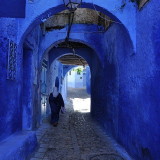
Chefchaouen is a picturesque city located in the Rif Mountains of northern Morocco. Known for its blue-washed buildings and stunning natural beauty, Chefchaouen has become a popular destination for tourists seeking a unique and peaceful escape from the hustle and bustle of other Moroccan cities.
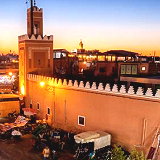
Jemaa el Fna is a bustling square located in the heart of Marrakech, Morocco. It's one of the city's most vibrant and lively public spaces, attracting both locals and tourists. During the day, Jemaa el Fna is a bustling hub of activity, with stalls selling a wide variety of goods, from fresh fruits and vegetables to traditional Moroccan handicrafts and souvenirs.
Marrakech is the fourth largest city in Morocco. It is one of Morocco's four royal cities and the capital of the Marrakesh-Safi region. The city is located at the western foot of the Atlas Mountains. The population of this provincial city was 1,002,697 in 2024. The city is divided into two parts: the Medina, the historical city, and the new European-style modern quarter.
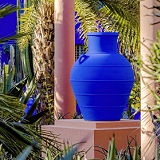
Jardin Majorelle, located in Marrakech, Morocco, is a famous botanical garden and artistic landscape that was designed by the French painter Jacques Majorelle. The garden is renowned for its vibrant blue color scheme, diverse plant collection, and its historical connection to the fashion designer Yves Saint Laurent.
The Bahia Palace is a 19th century building, consisting of rooms decorated with stunning stuccos, paintings and mosaics palace and a set of gardens located in Marrakech, Morocco. The Bahia Palace was intended to be the greatest palace of its time. The name of the Bahia Palace means in Arabic “brilliance”. There is a 2-acre (8,000 m²) garden with rooms opening onto courtyards in the Bahia Palace.
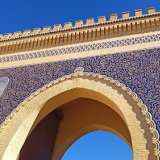
Fez is a city in northern inland Morocco and the capital of the Fez-Meknes administrative region. It is the second largest city in Morocco, with a population of 1.11 million, according to the 2014 census. Fez has a special atmosphere. This 13th-century city is an imperial city of long-lasting multicultural history, that reserves unexpected surprises for its visitors.
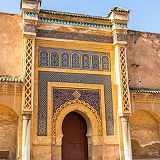
Meknes is one of the four Imperial cities of Morocco, located in northern central Morocco and the sixth largest city by population in the kingdom. Founded in the 11th century by the Almoravids as a military settlement, Meknes became the capital of Morocco during the reign of Sultan Ismail Ibn Sharif 1672–1727. The city recorded a population of 632,079 in the 2014 Moroccan census.
Tangier is a city in northwestern Morocco, on the coasts of the Mediterranean Sea and the Atlantic Ocean. The city is the capital of the Tanger-Tetouan-Al Hoceima region, as well as the Tangier-Assilah Prefecture of Morocco. Many civilisations and cultures have influenced the history of Tangier, starting from before the 10th century BCE. Its population was 1,275,428 in 2024.
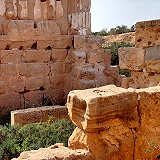
The ancient city of Sabratha, located in present-day Sabratah, Libya, was one of the major cities of the Roman province of Tripolitania. Founded by the Phoenicians in the 5th century BC, Sabratha became an important trading center, particularly for the exchange of goods between the Mediterranean and inland Africa.
The Sabratha Museum displays artifacts unearthed from the archaeological site, including sculptures, mosaics, pottery, and other relics from the Greco-Roman period. The museum's collection includes Roman mosaics depicting mythological scenes, statues and busts of Roman and local figures, and objects from the daily life and religious activities of the ancient city.
Sabratah, in Libya's Zawiya district, is the westernmost of the ancient "three cities" of Roman Tripolis, along with Oea and Leptis Magna. From 2001 to 2007, it was the capital of the former Sabratha wa Sorman district. It lies on the Mediterranean coast, approximately 70 km (43 mi) west of modern Tripoli.
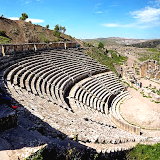
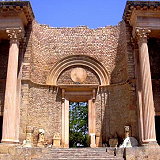
The ancient Sabratha Theatre is one of the most outstanding and best-preserved Roman architectural monuments in North Africa. Located in the ancient city of Sabratha, Libya, in the Roman province of Tripolitania, the theatre dates from the 2nd century AD, during the reign of Emperor Septimius Severus, who was born in nearby Leptis Magna.
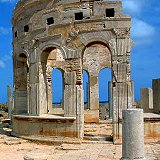
Lepics Magna, also known by various other names in antiquity, was an important city of the Roman Carthaginian and Libyan empires located at the mouth of the Wadi Lebda River on the Mediterranean Sea. Founded as a Punic settlement before 500 BC, the city underwent significant expansion under the Roman Emperor Septimius Severus (reigned 193–211), who was born there.
The Roman theater in Guelma dates from the late 2nd and early 3rd centuries AD, during the reign of Emperor Septimius Severus. It is a semicircular natural pit, its edges leveled and lined with plaster and cut stone to form steps and seating, creating what is known as the Roman amphitheater.
The Kigali Genocide Memorial commemorates the 1994 Rwandan genocide. It is the burial place of over 250,000 victims. The memorial serves as a place of remembrance and learning dedicated to the victims of the Tutsi genocide in Rwanda. It offers a profound experience for visitors, promoting reconciliation and peacebuilding through education.
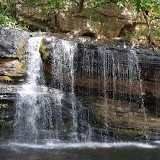
Tanougou Falls is a waterfall located in the Atakora Mountains, on the edge of the Pendjari Wildlife Sanctuary in northern Benin, about 20 km northeast of Tanguiéta. The falls are approximately 15 meters high and have an estimated flow rate of 1.5 m³ per second, although this figure varies considerably seasonally.
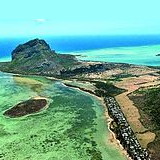
Le Morne Brabant is a peninsula located in the far southwest of Mauritius, an island in the Indian Ocean. The peninsula's highlight is the basalt massif of the same name, with its peak rising 556 meters (1,824 ft) above sea level.
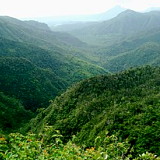
Black River Gorges National Park is a protected area located in the southwestern part of Mauritius, an island nation in the Indian Ocean. The park covers an area of 67.54 km2 and is known for its unique ecosystem, which includes dense forests, waterfalls, and a variety of endemic plant and animal species.
Mauritius is an island nation located in the Indian Ocean, approximately 2,000 km off the southeastern coast of mainland Africa. The country comprises the main island of Mauritius, as well as several smaller islands, including Rodrigues and Agalega. The capital is Port Louis, situated on the northwestern coast of the main island. The population of Mauritius was 1,265,475 in 2019.
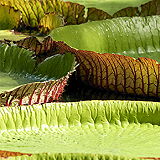
The Pamplemousses Botanical Garden, or Sir Seewoosagur Ramgoolam Botanical Garden, is one of the most visited sites in Mauritius and the oldest botanical garden in the Southern Hemisphere. Established under the administration of the Mahé de Labourdonnais by the king's governor, Pierre Poivre, over 300 years ago, the garden boasts a remarkable flora with countless native and endemic species.
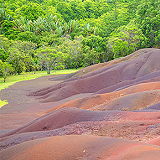
The Seven-coloured Earth is located in the heights of Chamarel. An unexpected site formed by a geological phenomenon that gave to the earth a palette of seven colours. This unique place deserves to be seen.
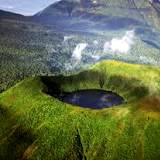
Mount Bisoke is an active volcano in the Virunga Mountains of the Albertine Rift, the western branch of the East African Rift. It straddles the border of Rwanda and the Democratic Republic of the Congo, but the summit is located in Rwanda.
Yankari Game Reserve is a large wildlife park located in Bauchi State, northeastern Nigeria. The park covers an area of approximately 2,244 km² (866 sq mi) and is home to numerous natural hot springs, as well as a diverse range of flora and fauna.
Mount Olumo is a mountain in southwestern Nigeria. It lies within the ancient city of Abeokuta, Ogun State, and historically served as a natural fortress during tribal wars in the 19th century. Its patron deity is worshipped in the Yoruba religion as an Orisha. The Mount Olumo Festival is held annually with numerous sacrificial offerings.